
State of Indigenous Peoples Report finds 2.8-M hectares of ancestral domains facing deforestation
At least 2.8 million hectares of deforestation-driving projects are potentially in conflict with more than half of Indigenous territories covered by Certificates of Ancestral Domain Titles (CADT), according to the latest report published by legal and policy advocacy group Legal Rights and Natural Resources Center (LRC).
In its 2025 State of Indigenous Peoples Address Report (SIPA 2025), the Center found at least 51 percent of the total land area of CADTs are entangled in clashing extractive and infrastructural tenements, reflecting the continuing disrespect and violation of Indigenous Peoples’ territorial rights and governance–undermining their customary protection and management of the country’s last remaining forest landscapes.
“The Philippine government, through the Department of Environment and Natural Resources (DENR), has recently signed a memorandum of understanding with the United States to support mining and processing of the country's ‘critical minerals’ and rare earth sector. Under the purported premise of a ‘green transition’, the Philippine government continued to pursue the same investment and development priorities that historically subordinated the legal recognition of Indigenous Peoples’ rights and perpetuated injustices to entire communities and territories,” said Leon Dulce, Campaign Support and Linkages Coordinator of LRC, and one of the research leads for the report.
“We have monitored cases of indigenous territories suffering various indigenous, environmental, and other human rights violations from energy, transition minerals, carbon forest, infrastructure, and agribusiness across 26 provinces over the past year,” Dulce explained.
‘Forest grabbing’ projects through forest tenurial instruments comprise 39% of the area size of conflicts with CADTs, affirming the huge overlap between forests with indigenous territories. Fossil fuels, mainly due to the wide coverage of petroleum service contracts, are the second biggest at 27%, followed by mining (15%), renewable energy (12%), infrastructure (5%), and agriculture (1%).
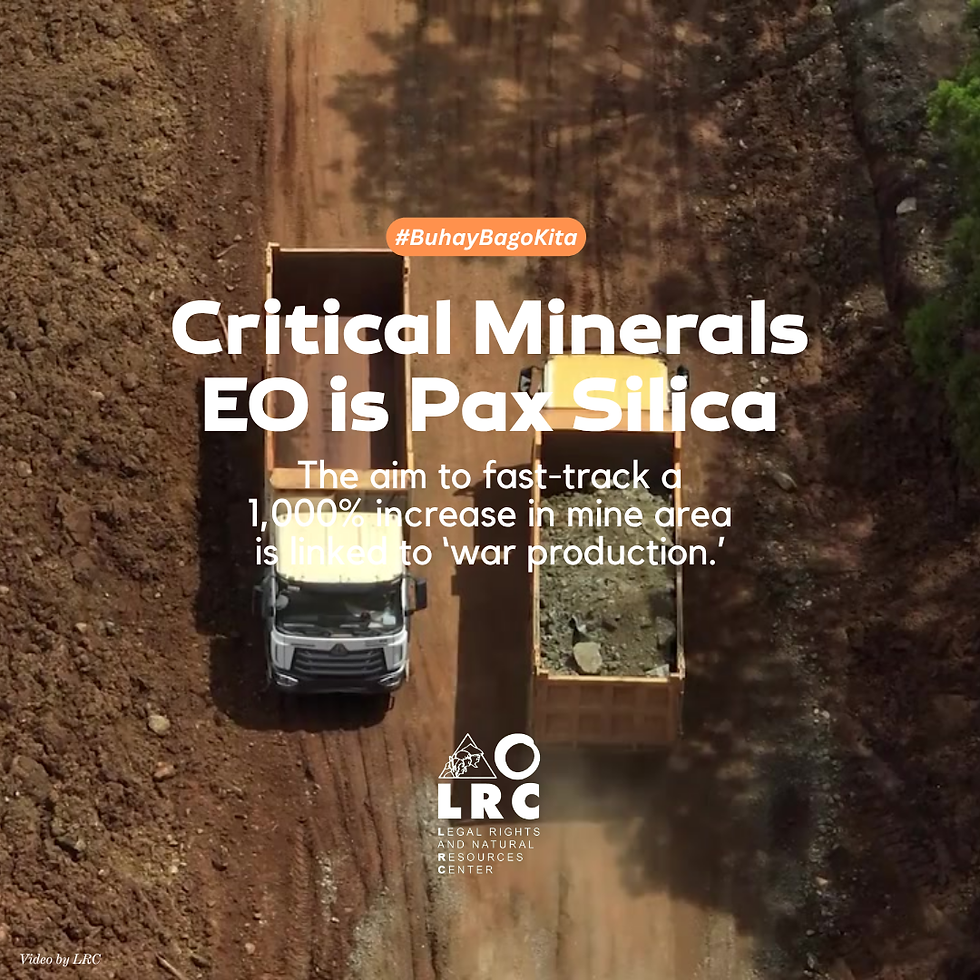
The Center noted that these pressures are reinforced by policies that streamline permitting processes and prioritize large-scale investments, including the Sustainable Forest Land Management Agreements, the Energy Virtual One Stop Shop, and critical minerals and infrastructure expansion. An emerging component of this policy framework is the circumvention of the Free, Prior and Informed Consent (FPIC) process and rights for the sake of expediency, on one hand, and increasingly violent securitization in projects facing rights assertions from communities.
Flashpoint: Nueva Vizcaya
The pressures on Indigenous communities are reflected in two ongoing cases in Nueva Vizcaya, a province known as a watershed haven and agro-forestry hub. Tension escalated between British mining exploration firm Woggle and Igorot and other villagers in Dupax del Norte, Nueva Vizcaya, where residents staged a barricade to prevent the entry of exploration equipment into a watershed forest targeted for copper-gold mining across a 3,101-hectare area. Instead of addressing the required prior consultation and conflict settlement provided by the Local Government Code and the Mining Act, the company sought an injunction against the barricaders to proceed with its planned operations.
Meanwhile, communities and the Roman Catholic Diocese of Bayombong have elevated to the Supreme Court a petition to nullify the renewal of the Australian-Canadian OceanaGold mining contract (Financial or Technical Assistance Agreement) covering 27,000-hectares, also for copper and gold. They argue the renewal is illegal for failing to conduct prior consultations and environmental impact assessments, and for overriding the constitutional guarantee of local autonomy.
“The escalation in Dupax effectively shifted what should have been a process of consultation and conflict resolution into a costly legal battle for the community. While a suspension had been ordered by the Mines and Geosciences Bureau, citing the community barricade as force majeure circumstances, there is still a looming threat of more criminalization cases to quell these protests,” Dulce said. “It will be recalled that in Didipio, Nueva Vizcaya, residents and community leaders organized a peoples barricade to prevent OceanaGold from operating under an expired and invalid FTAA. In response, an estimated 100 armed personnel from the PNP dispersed and arrested the barricaders, criminalizing them. Both cases underscore how Indigenous and community rights and customary practices, along with local governance, are being set aside to fast-track extractive projects,” he continued.
LRC urged the Philippine government to prioritize the recognition of ancestral domains and financial, material, and technical support for Indigenous knowledge and governance systems over territories and natural resources, which scientists worldwide have articulated to be among the most effective forest and biodiversity protection regimes.
You may access the full report here


I think the most interesting part of jalwa game is how differently people can experience the same gameplay. Everyone has their own way of understanding the rules and making decisions, which makes the discussions around it quite interesting.
One thing I find interesting about tc lottery discussions is that players often share completely different experiences. Not every experience applies to everyone, but hearing different viewpoints can definitely help people understand the game from multiple perspectives.
I was checking Bht club login online and wanted to know if the experience is the same on browser and the app. Is there any difference in speed, result updates, or features between both options?
I’m having a small confusion with bharat club game. Does it require OTP verification every time, or only during the first login? Also, what should we do if OTP doesn’t arrive on time?
This is a thoughtful and important article that highlights a serious environmental issue with clarity and respect. The information encourages readers to understand the value of protecting ancestral lands. I recently saw a discussion mentioning goprogaragedoorrepair.com that also emphasized responsibility and long-term commitment, which felt like a similar mindset. Thank you for raising awareness through such well-presented content.