
Marcos SONA bodes dirty energy and critical minerals boom
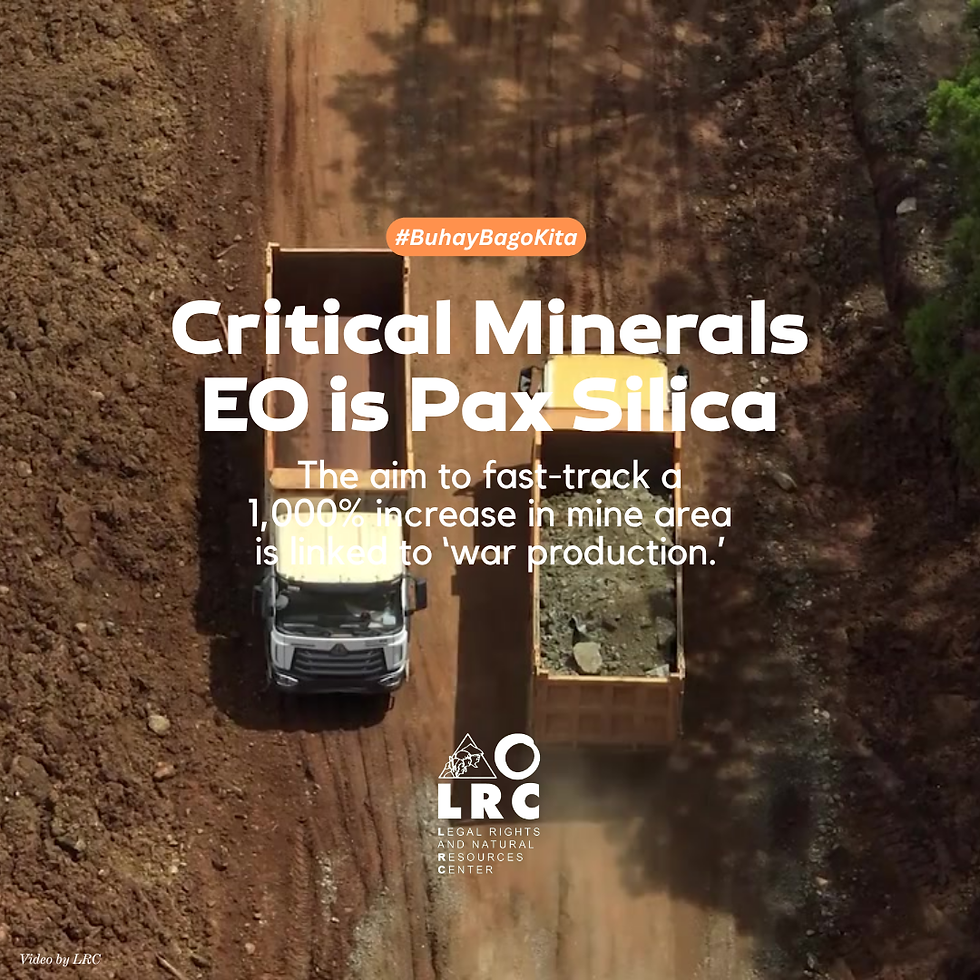
(Quezon City—July 27, 2026) Legal, policy and advocacy group Legal Rights and Natural Resources Center (LRC) warned that the latest pronouncements of President Ferdinand ‘Bongbong’ Marcos Jr. in his fifth State of the Nation Address is pointing to a dirty energy and mining boom anchored on a resurgence of fossil fuel development and expansion of critical minerals demand.
“Pres. Marcos Jr. 's declared pursuit of massive petroleum contracts, over 200 energy projects, a nuclear energy program, and a Pax Silica-driven infrastructure development builds on an unspoken increasing wholesale and deregulation of our environment. Unmentioned in the Marcos administration’s fifth SONA is their facilitation of corporate takeovers of natural resource-rich lands through the dilution of the Free, Prior, and Informed Consent (FPIC) rights and regulations for Indigenous Peoples and various policies that worsen forest tenurial insecurity,” said Atty. Mai Taqueban, executive director of LRC.
“Over 2.8 million hectares of forested indigenous territories are presently in conflict with these critical minerals, fossil fuel, renewable energy, and other land grabs that the Marcos government is aggressively promoting. This may very well double in the near future as indigenous lands that have traditionally safeguarded biodiversity and natural resource corridors are now being opened up,” Atty. Taqueban warned.
In its 2025 State of Indigenous Peoples Address Report, the Center noted these conflict lands represented 51% of the total area of issued Certificate of Ancestral Domain Titles (CADTs) at present.
Ancestral domains are known to overlap with 75% of the Philippines’ remaining forest cover and 85% of the country’s identified Key Biodiversity Areas. The preservation of species, ecosystems, and natural resources within Indigenous territories are attributed largely to their customary governance and knowledge systems and practices.
But with the National Commission on Indigenous Peoples (NCIP) confirming in a recent dialogue that the promulgated guidelines featured shortened timelines and processes and exemptions for vested rights within Ancestral Domains, among others, the Center warned that Indigenous communities will be systematically restricted from regulating potentially destructive projects encroaching into their lands.
“The numerous draft iterations of the new FPIC Guidelines announced by the NCIP are characterized by shortened timelines and processes, diminished roles and powers of indigenous communities and political structures, and weakened mechanisms on regulations, grievance, and remedies,” explained Atty. Taqueban.
The Center noted that the noticeable shift from an almost exclusive renewable energy rhetoric towards clear mentions of fossil fuels and nuclear energy is a clear abandonment of previous framings of a just energy transition pathway.
“If the Marcos government continues to put our environment at risk, undermine Indigenous Peoples’ rights, and ignore the various critical gaps in our environmental and social regulations, dreams of Pax Silica may very well be Pax Mortis–a peace of the dead. We must return to the pathway of a transformative and just energy transition that anchors on the rights and solutions of Indigenous Peoples and Local Communities and meaningful development for the country,” Atty. Taqueban ended. ###


A se lekar Gya tak hindi varnmala ko samajhna ab easy lag raha hai. Beginners ke liye achha article hai.
Once you've unlocked multiple sleds, experiment with their handling. A sled that feels comfortable and responds well to your steering Snow Rider can be more useful than simply choosing one because it looks impressive.