
Sibuyan Island: Ecosystem approach ideal in trying mining cases

Catingas River, Sibuyan. Credit: Matthias Dans/LRC.
By Matthias Dans
Sibuyan Island is a sanctuary of vital watersheds and endemic biodiversity, globally renowned as the "Galapagos of Asia". But today, this fragile ecosystem faces an existential threat from the mining exploration activities of Altai Philippines Mining Corporation (APMC). For three years, the people of Sibuyan have bravely held the line through community barricades and legal petitions.
Sibuyanons sought refuge in the highest courts, and in 2023, the Supreme Court issued a writ of kalikasan against the mining firm. Yet, that victory was short-lived because of the recent dismissal of this petition by the Court of Appeals, based on a technicality: the requirement that environmental damage must affect two or more cities or provinces.
Because Sibuyan Island is contained entirely within the province of Romblon, the court concluded the remedy did not apply. Under the Rules of Procedure for Environmental Cases (RPEC), the "magnitude" is equated with "political boundary crossing". In an archipelago, an entire island ecosystem can be destroyed, but if that island constitutes only one province (as many do), the damage is deemed legally insufficient for the kalikasan writ—even if the ecological catastrophe is total. Ecological systems do not respect political boundaries.
However, this narrow interpretation ignores the fundamental realities of nature—a flaw pointed out by Supreme Court Senior Associate Justice Marvic Leonen. Justice Leonen has consistently championed an ecosystems approach to environmental law, arguing that courts must look beyond artificial political boundaries. Nature does not carry a passport, nor does it recognize municipal lines. When a critical watershed is poisoned, or an old-growth forest is cleared, the impact is never truly "localized", their destruction can be "of such magnitude" as to deserve the highest level of judicial protection. The rule imposes an artificial jurisdictional requirement that ignores ecological reality.
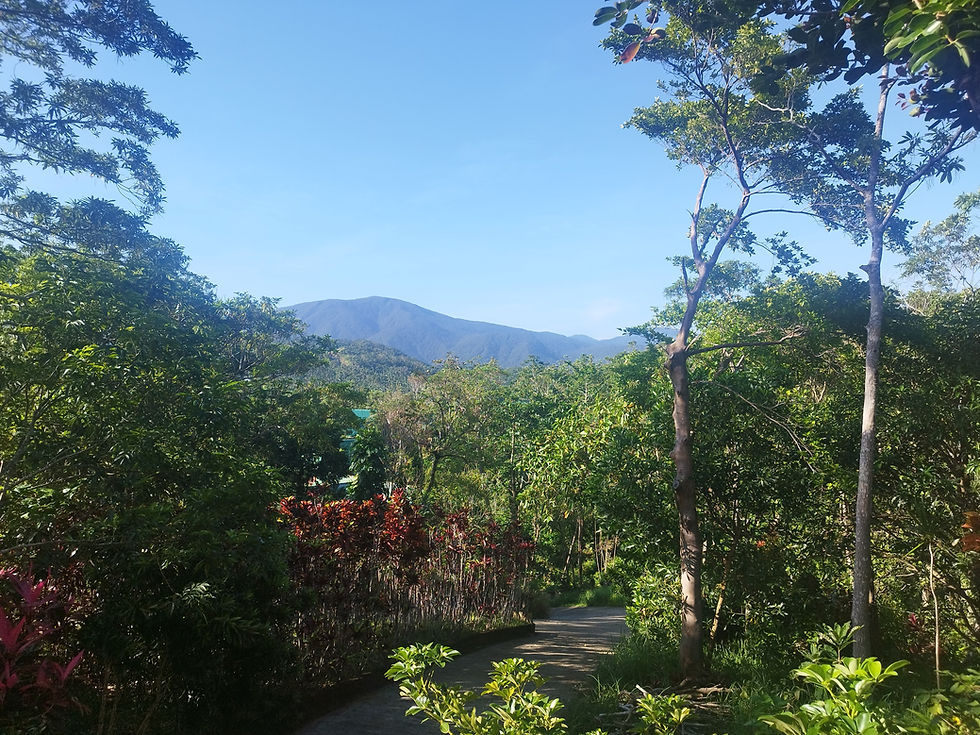
Sanctuary Garden. Credit: Matthias Dans/LRC.
In the case of Sibuyan, the destruction of its ecosystem has profound ripple effects. The
disruption of Sibuyan's carbon-sequestering forests directly contributes to the broader
climate crisis, which affects multiple provinces across the archipelago. By forcing environmental damage into the neat demarcation of political maps, the current application of the law fails the very environment it was designed to protect. Leonen's ecosystem approach reminds us that environmental justice cannot be defeated by geography.
Until the jurisprudence catches up to this ecological reality, the people of Sibuyan must rely on grassroots, localized legal remedies. But they do so knowing that the fight to protect their island is, in truth, a fight to protect the interconnected web of life that sustains us all.
However, unlike the writ of kalikasan, local citizen suits demand a much higher standard of tangible evidence. They require proof of direct injury, precise documentation of ecological damages, and sworn affidavits that can withstand the intense scrutiny of cross-examination. The hard truth is that our community currently lacks the technical capacity to consistently gather this "court-admissible" evidence.
This is exactly where the Sibuyanon are stepping in. On January 30 and 31, 2026, a coalition of 30 youth leaders gathered at Sanctuary Garden in Magdiwang, for the Sibuyan Youth Environmental Leadership & Paralegal Camp. Organized by the Legal Rights and Natural Resources Center (LRC) and Sibuyanons Against Mining, this initiative was designed to transform young, passionate residents into technically capable community paralegal teams.

Youth participants learn more environmental laws, affidavit-making, and conservation. Credit: Matthias Dans/LRC.
The diverse composition of the camp proved effective. We intentionally moved beyond student councils. The camp integrated academic achievers from Romblon State University with grassroots youth from the Sangguniang Kabataan and, vitally, the "unaffiliated" youth rooted deeply in the farming and fishing communities of Magdiwang, San Fernando, and Cajidiocan. By doing so, we are bridging a crucial gap: combining the strong writing and research skills of students needed for drafting affidavits with the intimate knowledge of the terrain, forest trails, and coastal movements possessed by local youth—the exact knowledge needed for on-the-ground evidence gathering.
During the camp, these youth leaders engaged in rigorous, practical training. They learned how to take admissible, geo-tagged photos, drafted one-page sinumpaang salaysay (affidavits), and conducted mock inspections to learn the rules of evidence. They grounded their legal knowledge in their ecological heritage, learning to identify and document threats to vulnerable native species like the Tiga (Philippine ironwood), the massive Almaciga tree, and the endangered Hopea foxworthyi. This inclusive mix ensures that the environmental movement is grounded firmly in the reality of those whose very livelihoods are immediately threatened by mining operations.

Participants create environmental maps of their areas. Credit: Matthias Dans/LRC.
While these localized citizen suits serve as our immediate line of defense, securing the ultimate protection of Sibuyan requires systemic policy change. We strongly urge lawmakers to pass the Alternative Minerals Management Bill (AMMB), which seeks to replace the flawed Mining Act of 1995 and permanently declare fragile island ecosystems and critical watersheds as absolute "no-go zones" for extractive industries. Enacting this progressive legislation will institutionalize a rational, community-led framework that prioritizes ecological preservation over corporate profit, ensuring that our national patrimony is not sold off. While the AMMB does not prohibit mining itself, it supports local decision making, cognizant that communities and local governments know intimately—and depend on—local ecosystems.
The barricades of Sibuyan will always stand as a testament to the community's spirit. As the legal landscape shifts, this and other tactics at the grassroots level will prove invaluable in conserving nature.

The community barricade celebrated their third anniversary in 2026. Credit: Matthias Dans/LRC.



Really helpful post! One thing I was curious about do you have any advice for PRP Treatment In Marina Del Rey? Would love to hear your thoughts.