
Unpacking the concept of friendshoring
Updated: May 8
Trade, as one of humanity’s oldest and most defining social activities (Curtin, 1984; Frank & Gills, 1993), has shaped and been shaped by power. Today, the global trading system is at a pivotal point. What we are witnessing is not a simple shift, but an active reconstruction, driven by state and corporate powers as they grapple with the converging crises of climate, supply chains, and geopolitical tension.
The emerging strategy of “friendshoring” is presented as a pragmatic, technical solution for building resilient supply chains. However, a deeper examination is necessary. Friendshoring has been defined as the “manufacturing and sourcing of components and raw materials within a group of countries with shared values” (Kollewe, 2022). Another perspective posits it more succinctly as the integration of economic partnerships within established military alliance structures (DeCarlo & Perry, 2023).
Viewing friendshoring from a political economy lens—one that critically examines the distribution of power, wealth, and class interests embedded in economic structures—reveals multipolarization and a re-territorialization of global capital. For the Philippines and its ASEAN neighbors, this moment is not a simple choice between alignment and non-alignment, but a complex internal and external negotiation within a new architecture of core-periphery relations (Prebisch & Singer, 1950). The central challenge is to navigate this recalibration without regional fragmentation and without reinforcing the historical role of the region, and more particularly of the Philippines, as a subordinate provider of cheapened nature, labor, and resources (Patel & Moore, 2017).
A sober reading of Philippine history reveals a persistent pattern: trade agreements have rarely been neutral instruments of mutual gain. More often, they have been mechanisms for consolidating elite power and integrating the national economy into the global capitalist order on unfavorable terms. The colonial economy was structured around a comprador class that facilitated extraction. In the modern era, this dynamic was reconfigured, not dissolved, into a model of dependent development where local elites form alliances with international capital, prioritizing integration into global markets over genuine and self-sustaining industrialization—a pattern that, arguably, perpetuates underdevelopment (Cardoso & Faletto, 1979).
Since its independence, the Philippines has entered into hundreds of trade agreements. Yet over time, the country’s position has eroded, with its role as exporter declining and its economy becoming increasingly import-dependent. The Philippines’ accession to the World Trade Organization, along with subsequent bilateral and plurilateral treaties, is chronicled to empower a domestic coalition whose interests are tied to global finance and export-oriented production (Bello et al., 1982), often at the expense of national industrial capital, the peasantry, and Indigenous Peoples. Too often, the state has acted to secure these arrangements, privileging capital over the broader populace (Tadem, 2014). In other words, this integration has made risks more acute for ordinary people, fostering a growing precariat as labor and natural resources are extracted by a consolidated oligarchy and oligopoly.
This process unfolded within a specific global structure: the buyer-driven commodity chain (Gereffi, 1994), in which lead firms in the Global North captured high-value segments like branding and research and development, while outsourcing low-value, labor-intensive manufacturing and extracting raw materials and natural resources from the South. This model also systematically relied on the gendered exploitation of labor or what feminist scholars illustrate as “nimble fingers make cheap workers” (Elson & Pearson, 1981). The neoliberal project that institutionalized this model created a global constitution of capital, actively shrinking the “development space”, including the capture of the very tools like subsidies and tariffs that today’s wealthy nations used to build their own industries (Wade, 2003; Chang, 2002). In the region, this also led to a “race to the bottom” as members competed as low-cost destinations. The result was not mere liberalization, but a re-engineering of social relations, class, and gender that weakened labor and community rights, and strengthened the hand of capital (Benería et al., 2015). The mining industry illustrates this dynamic: despite vast mineral reserves, the Philippines remains locked in an upstream role, exporting raw ores without developing domestic capacity for higher-value processing, thereby failing to capture significant revenue from its own resources while bearing the brunt of greater environmental damage.
This class-power dynamic is starkly visible in the contest over critical minerals, alternately termed transition minerals. The Philippines, with its significant reserves of nickel, cobalt, and copper, finds itself at the center of the global supply chain for these resources. The discursive shift from “critical” to “transition” is politically crucial. The dominant “critical minerals” narrative, driven by geopolitical and corporate strategy, frames such minerals as strategic necessities for national security and economic competitiveness—the supply anxieties of powerful industrialized nations—as the focal point. In contrast, the concept of “transition minerals” explicitly links them to the climate imperative, centering the goal of a low-carbon future. For the Philippines and other resource-rich nations of the Global South, this is not a semantic distinction but a strategic one. An uncritical adoption of the “critical minerals” framework risks reducing the nation to a geopolitical pawn and a mere source of extractive supply, its resources extracted to secure the energy security of others. Embracing the “transition minerals” framework creates a normative imperative to ask: A transition for whom, and on whose terms? It demands that the extraction and processing be held accountable to the benchmarks of a just transition, prioritizing ecological integrity, community rights, and domestic industrial upgrading over mere export volume.
Yet the domestic political economy of mining presents a formidable obstacle. It is characterized by a powerful nexus of transnational corporations and local elite interests, a legacy of the dependent development model. A friendshoring agreement negotiated through this nexus would be a Pyrrhic victory, reinforcing what is an already weak and rent-seeking character of the Philippine state (Hutchcroft & Rocamora, 2003). Such a deal would likely facilitate a rush of extraction under the banner of climate action, perpetuating the “cheapening” of nature and communities (Patel & Moore, 2017) in service of a “green” capitalism that reproduces old inequalities. The “transition” would be captured by entrenched interests, leaving behind deepened social fissures and ecological degradation.
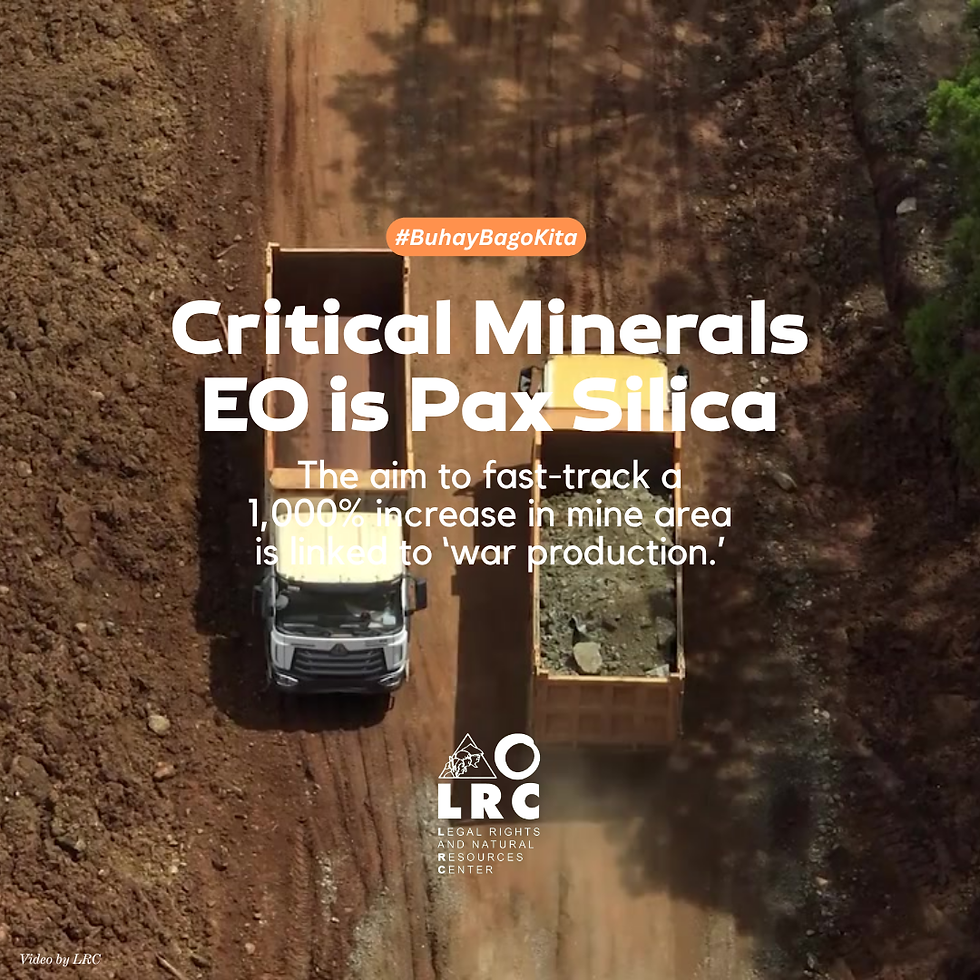
Recent US policy emphasizes friendshoring particularly for critical minerals, characterizing it as the movement of its supply chains to geopolitically aligned countries in the Indo-Pacific, to lessen its dependence on China (Mellsop, 2025). It initiated the Minerals Security Partnership (US Department of State, 2025), which later evolved into the Forum on Resource Geostrategic Engagement, a bloc of 56 countries aimed at securing and diversifying supply chains for critical minerals (Kim, 2026). At the same time, it is actively garnering support against its geopolitical rival—i.e., “US eyes Philippine rare earths to counter China’s ‘chokehold’” (Robles, 2025). The Philippines recently signed a memorandum of understanding with the US, stating it is “a significant step towards deepening bilateral cooperation on critical minerals” (Philippine Embassy in Washington DC, 2026). The Philippines also signed on to the US-led Pax Silica, which seeks to secure the supply chains essential to AI, particularly silicon and critical minerals, and is also underpinned by the motivation to counter China. Pax Silica makes apparent the escalating geopolitical competition over AI and the critical minerals needed for its infrastructure and to sustain its powering.
Meanwhile, the Philippines is also a signatory to the Regional Comprehensive Economic Partnership (RCEP), a multilateral economic partnership that China strongly pushed to strengthen its economic foothold in the rest of Asia (Bimo, 2025). Its provisions include tariff reduction among RCEP parties, including those for mineral ore, ash, and slag (IEA, 2024). As the largest participating economy in the RCEP, China is expected to capitalize on the RCEP to secure its supply chains and its ties with the ASEAN member states, Japan, South Korea, New Zealand, and Australia. China has also established broad economic and diplomatic relationships with countries that have critical minerals, evident in those participating in its Belt and Road Initiative, positioning China as global leader in the processing of critical minerals (de Matos, 2026).
Hence, the contest over critical minerals—which are indispensable for renewable energy, advanced technology, and defense systems—is reshaping global geopolitics. While the rivalry is dominated by the US and China, other players are in the fray: the European Union, Russia, the Arab states, India, Brazil, and other resource-rich nations across the Global South. There is also a discernable shift toward resource nationalism. These developments signal a move away from the bipolar dynamics of the previous decades toward a more intricate, multi-layered competition involving a diverse array of states and regions, leading to an ever more complex multipolar world.
The new discourse of friendshoring must grapple with this underlying structure and the distribution of power it sustains—both globally and nationally. To approach it uncritically risks substituting old colonial dependencies with new strategic ones, where the needs of powerful states replace imperial decree, and the outcome of asymmetrical value extraction remains unchanged. The danger is that “friendship” becomes a euphemism for intensified resource extraction and a new division of labor, reinforcing, in the case of the Philippines, a position at the lower rungs of a green commodity chain. This would not be development, but a continuation of the globalization paradox, where hyper-globalization undermines democratic sovereignty and equitable outcomes (Rodrik, 2011).
A just transition is thus inseparable from the project of system change: meaningful domestic democratization and state transformation. It requires reclaiming policy spaces to build countervailing power. The goal must be to use external negotiations to leverage to build internal capacity to: mandate technology transfer, ensure royalties fund community development, and embed enforceable clauses that empower communities and workers, among others, more than corporations.
Therefore, friendshoring must be seen as fundamentally a political struggle—not merely a technical negotiation—and as a pursuit of equity. It demands a conscious effort to reshape both the internal and external balance of forces. This entails moving beyond a state-centric view of “national interest” to ask: which domestic classes and social groups will benefit from this new arrangement, and who will bear the costs? Only through such clarity can friendshoring be assessed for its real benefits and its alignment with national development aspirations within regional cooperation.
LRC’s paper, From peripheries to the core: Leveraging Southeast Asia’s centrality in global minerals supply chain through regional friend shoring, then, is a call for clear-eyed and politically sound engagement with friendshoring. It argues that the Philippines and the ASEAN must not be passive objects in this realignment, but active subjects seeking to rewrite the rules of the game. A crucial test is whether or not the ASEAN can move from mere compliance with external frameworks to proactively define its own rules for resource governance, sustainable production, and labor rights, thereby establishing the mechanisms for friendshoring within and among its members, and setting the standards for ethical and equitable friendshoring. By grounding the analysis and strategy in a critique of dependent development, asymmetric commodity chains, and the historical suppression of policy space, we can work toward a future where strategic realignment and climate action become the catalysts for an equitable economy and true ecological balance, both within our nations and across the region.
The author, Mai Taqueban, is the executive director of the Legal Rights and Natural Resources Center -Friends of the Earth Philippines (LRC-FoE Ph).
References
Bello, W., D. Kinley, & E. Elinson. (1982). Development debacle: The World Bank in the Philippines. Institute for Food and Development Policy.
Benería, L., G. Berik, & M.S. Floro. (2015). Gender, development and globalization: Economics as if all people mattered (2nd ed.). Routledge.
Bimo, E.S. (2025, September 23). China-backed free trade giant RCEP mulls expansion and upgrade. The China-Global South Project. https://chinaglobalsouth.com/2025/09/23/china-rcep-expansion-upgrade-asean-summit-kuala-lumpur/ (accessed on 14 February 2026).
Cardoso, F.H. & E. Faletto. (1979). Dependency and development in Latin America. University of California Press.
Chang, H.J. (2002). Kicking away the ladder: Development strategy in historical perspective. Anthem Press.
Curtin, P.D. (1984). Cross-cultural trade in world history. Cambridge University Press.
DeCarlo, S. & A. Perry. (2023). Why can’t we be friends? Friendshoring the REE supply chain (Executive Briefings on Trade, April 2023). U.S. International Trade Commission. https://www.usitc.gov/publications/332/executive_briefings/ebot_friendshoring_ree.pdf.
De Matos, L.P. (2026, January 15). China’s alchemy: How it transforms critical minerals into global power. CaixaBank Research. https://www.caixabankresearch.com/en/economics-markets/commodities/chinas-alchemy-how-it-transforms-critical-minerals-global-power (accessed on 13 February 2026).
Elson, D. & R. Pearson. (1981). ‘Nimble fingers make cheap workers’: An analysis of women’s employment in third world export manufacturing. Feminist Review, 7(1), 87–107.
Frank, A.G. & B.K. Gills (Eds.). (1993). The world system: Five hundred years or five thousand? Routledge.
Gereffi, G. (1994). The organization of buyer-driven global commodity chains: How U.S. retailers shape overseas production networks. In G. Gereffi & M. Korzeniewicz (Eds.), Commodity chains and global capitalism (pp. 95–122). Praeger.
Hutchcroft, P.D. & J. Rocamora. (2003). Strong demands and weak institutions: The origins and evolution of the democratic deficit in the Philippines. Journal of East Asian Studies, 3(2), 259–292.
Patel, R. & J.W. Moore. (2017). A history of the world in seven cheap things: A guide to capitalism, nature, and the future of the planet. University of California Press.
International Energy Agency (IEA). (2024, June 6). Regional Comprehensive Economic Partnership (RCEP). https://www.iea.org/policies/18409-regional-comprehensive-economic-partnership-rcep (accessed on 14 February 2026).
Kim, D. (2026, February 5). South Korea chairs U.S.-led FORGE critical mineral bloc. The Chosun Daily. https://www.chosun.com/english/national-en/2026/02/05/FMC6AHM2INC4LF3JT2ZVHGHX5Q/ (accessed on 14 February 2026).
Kollewe, J. (2022, August 6). Friendshoring: What is it and can it solve our supply problems? The Guardian. https://www.theguardian.com/business/2022/aug/06/friendshoring-what-is-it-and-can-it-solve-our-supply-problems (accessed on 14 February 2026).
Mellsop, J. (2025). That’s what (economic) friends are for: Guiding principles to boost supply chain security. Asia Society Policy Institute. https://www.wita.org/wp-content/uploads/2025/03/Final-Thats-What-Economic-Friends-Are-for-March-3-2025.pdf.
Philippine Embassy in Washington D.C. (2026, February 4). Philippines signs MOU on critical minerals supply chains. https://philippineembassy-dc.org/philippines-signs-mou-on-critical-minerals-supply-chains/ (accessed on 14 February 2026).
Prebisch, R. & H.W. Singer. (1950). The economic development of Latin America and its principal problems. United Nations.
Robles, R. (2025, July 30). US eyes Philippine rare earths to counter China’s chokehold. South China Morning Post. https://www.scmp.com/week-asia/health-environment/article/3320113/us-eyes-philippine-rare-earths-counter-chinas-chokehold (accessed on 14 February 2026).
Rodrik, D. (2011). The globalization paradox: Democracy and the future of the world economy. W.W. Norton.
Tadem, T.S.E. (2014). Philippine technocracy and the politics of economic decision-making: A comparison of the martial law and post-martial law periods. Southeast Asian Studies, 3(2), 345–381. https://doi.org/10.20495/seas.3.2_345.
U.S. Department of State. (2025, January 8). Minerals Security Partnership. [Archived content]. https://2021-2025.state.gov/minerals-security-partnership/ (accessed on 14 February 2026).
Wade, R.H. (2003). What strategies are viable for developing countries today? The World Trade Organization and the shrinking of ‘development space’. Review of International Political Economy, 10(4), 621–644.


Comments